Sunday, July 26, 2015

From Buckhorn Yacht Harbor to Fenelon Falls

July 20, 2015 - July 21, 2015


Beautiful outdoor living spaces created along the water's edge

July 20, 2015

On Monday, we discover that the mail we had sent to Buckhorn has not arrived so we decide to stay for another day.  We take advantage of this time and do some repairs to the generator and the dinghy engine as well as a minor repair to the canvas.  We wash and clean up the boat and defrost the freezer.  I also have the opportunity, due to free WiFi, to update the blog.  The weather is just beautiful, the water is crystal clear and warm, so we take advantage of the conditions and enjoy swimming.  We hope the mail arrives tomorrow.

July 21, 2015

Lock #32 Bobcaygeon
We wait until the mail delivery for the day and learn that there is still no mail for us.  We decide to continue on our journey and Pat, the office manager, agrees to send the mail to us when it arrives.  Our next stop at a marina will be at the Wye Heritage Marina in Midland, ON in Georgia Bay.  We should arrive there in 3 or 4 days.  By 1:30, we leave the wall and head to our next lock, #32 Bobcaygeon.  This lock is located in a very narrow and busy channel and it runs right through the center of the village.  There is a large "Happy Days Houseboat" rental on the right wall that is going to enter the lock ahead of us.  The captain has a difficult time getting the boat into the lock, but finally enters. The bow of the house boat is secured, but the stern is not and is swinging to the left where we must enter to tie up to the port wall.  The locks man on the loudspeaker states that "the trawler on the wall can enter the lock"……we are not moving an inch until the houseboat is secure inside the lock.  After several minutes, we enter the lock and lock through successfully.  Since it is still early, we continue to lock #34, Fenelon Falls.  The next 2 miles of the journey passes through a narrow channel.  We must pay attention as there are narrow passage ways with grass and deadheads as well as rock.  Dave phones the lock to ask if there is space above the lock for us to stay for the night.  We are told the only available space is below.  We do not arrive in time to lock through anyway, but as we approach the lock, we realize that space below is also at a premium.  We take the last available space on the "blue line" and At Last's bow is actually a bit in the lock.  We have a bite to eat and then walk to a grocery store for a few        items before returning to the boat and settling down for the night.                                                            

Houseboat in Bobcaygeon waiting 
           to enter lock


Monday, July 20, 2015

The Trent-Severn Waterway and Locking

Dave and I decided to include this post to give everyone an idea of where we are and how the process of locking works.


This image shows the series of 45 locks that make up the Trent-Severn Waterway.  Boats travel the Trent-Severn through several different types of locks.  

Conventional Locks
There are 37 conventional locks on the system which act as steps in the water staircase raising boats up 182 meters (597 feet) from Lake Ontario to Balsm Lake, and then lowering them down 80 meters (263 feet) to Georgian Bay.  A conventional lock has watertight gates made of timber or steel at both ends and are filled and emptied through sluices in the gates, walls or floor of the lock chamber.  The lock staff operates some of the gates and sluices manually.  However, many are now operated by electrically controlled hydraulic systems.  At some locks in the lower Trent Canal, one end of the lock is manual while the other is hydraulic.

The basic operation of the conventional lock is very simple:

1.)  The water in the lock has been emptied through the lower valves, and is now at the same level as the lower reach where our boat waits.  The lower lock gates have been opened to prepare for the lockage.

2.)  The boat enters the lock, the gates close forming a water tight chamber.  The upper valves are opened, allowing water from the upper ready to flow by gravity into the lock.  Our boat floats upwards as the lock fills.
3.)  When the water is the same level as the upper reach, the upper gates are opened, and our boat continues upstream.  The lock is now ready to lower boats heading in the other direction.


Simple! No pumps are needed.  It is all done by valves and gravity.


Flight Locks
A flight lock consists of two or more locks joined together to handle large changes in water levels.  There are 2 flight locks on the Trent-Severn Waterway--Ranney Falls (Locks 11 and 12; total lift:  48 feet) and Healey Falls (Locks 16 and 17; total lift:  54 feet)--with 2 lock chambers and 3 sets of gates each.

Hydraulic Lift Locks
Canada's hydraulic lift locks are 2 of only 9 of this type of lock in the world, and the only 2 in North America.  The Peterborough Lift Lock is the highest of the 9.  (Kirkfield is #2.)  Lift locks are made up of 2 water-filled chambers counterbalanced on huge hydraulic pistons.  As one descends, the other is forced upwards.

The Marine Railway
At Big Chute, "Lock 44" is, in fact, not a lock but a 3-storey-tall open carriage that rides on twin tracks and portages your boat over land.  You drive the boat onto the partially submerged carriage, where it is cradled snugly in slings as the water drains off.  The boat is refloated at the end of the railway's 600-foot journey.

Campbellford, Ontario to Buckhorn, Ontario

$2 Coin Statue Old Mill Park, Campbellford, ON
July 17, 2015 - July 19, 2015

We leave the wall and head for a challenging day of locking.  There are five locks in quick succession for the next five miles, starting with lock #13, Campbellford.  In this lock, all vessels must tie up on the port side due to water valves being on the starboard side.  Crowe Bay, lock #14 is only about a mile away and vessels must tie up in the lock on the starboard side since the water fill valves are on the port side.  At the next lock, Healey Falls, #15, once again you must switch to the port side for locking through.  This keeps both Dave and I busy as we must switch some of the fenders from side to side.  Remember, we popped one of our best fenders in the Ottawa staircase.  At Healey Falls Flight Lock, #16, 17, we can choose which side to lock through on and of course, we choose starboard, our favorite.  We lock through Hastings #18, and pull up to the wall just after the lock for the night.  It is a quick walk across the grass to an LCBO store, a convenience store, and an ice cream stand.  We purchase a few items and head back to the boat just as the rain begins.
Snapping Turtle in the Healey Falls Flight Lock
Very Ugly
July 18, 2015

We leave Hastings around 7:00. Our next lock is almost 20 miles away.  We must first cross a section of Rice Lake which is dotted with islands, secluded coves and resort marinas.  In Indian times the lake was a giant granary and was named for the wild rice that grows around its shores.  After crossing the lake, we proceed up the Ontonabee River where we saw several beautiful houses in idyllic settings.  Our destination today is Lakefield, lock #26.  But before we get there, we are going to experience the Peterborough Lift Lock, #21.  Today is a Saturday and by the time we reach lock #19, we no longer have the luxury of locking through alone.  We are joined by several other boats as we advance to the lift lock.

"The Peterborough Lift Lock, #21, is the world's highest hydraulic lift lock.  The boats "float" up the 65-foot vertical lift.  When the lock opened in 1904, the lock was an engineering marvel.  Even today, more than 110 years later, it is still a remarkable operation to watch, and even more remarkable to be lifted in it!  Boats are tied on to the horizontal black rails on the side of the locking pan.  The hydraulic lift lock works like a simple balance beam scale.  At the green light, your boat enters a large, rectangular chamber shaped like a giant sheet-cake pan.  Parallel to that chamber, but up a huge piston, is another chamber---a twin to the pan you are in.  There are 330,00 gallons of water that weigh 1,500 tons in each pan.  When the upper chamber is filled with an extra foot of water--1 foot equals 130 tons--the increased weight in the upper tank forces it to go down, while the lower tank rises on its piston, boats and all.  It does not matter how many or what size boats are in each pan.  The boats displace their own weight.  The trip is very fast.  It only takes about 2 minutes to complete the actual transfer."

When we reach the lock, there are two boats ahead of us.  Once they are tied up, one on the port side, the other on the starboard, Dave pilots the boat to the starboard side of the lock, where I use the boat hook to grab the rail, secure a line around the rail and then cleat it off on the boat.  Two smaller boats tie up across from us on the port side.  The lift begins and it is exciting to watch the scenery change as you are lifted higher and higher.  As the description in our Waterway Guide indicated, the lift is over way too soon, but it has been an enjoyable experience.  The locks men empty the lower pan first and then we are allowed to exit the lock.

Peterborough Lift Lock
(2 pans)
Lift Lock
Upstream Pan
Watching from the top of the lock
Boats on our port side in the lock
Looking out over the railing from the side
Looking downstream 
After leaving the lock, we continue through Nassau Mills, #22, Otonabee, #23, Douro, #24, Sawer Creek, #25, and Lakefield #26, where we pull up to the wall for the night.  There are several boats at the wall already.  It has been a hot, sweaty day and so Dave and I take a swim in the clear, fresh water to cool off.  At the suggestion of the locks man at the Lakefield Lock, we walk into town for dinner at an English Pub.  Today we rose a total of 149 vertical feet.

July 19, 2015

We decide to leave the wall early.  We have about a 5 mile ride to the next lock, #27, Youngs Point and we would like to catch the first lock opening at 9:00 am.  We continue on the Otonabee River through a narrow section of a marked channel into Lake Katchewanooka, which is the first of the Kawartha Lakes, until we reach the Youngs Point Lock, #27.  We are early, but there is a large houseboat waiting on the port side wall.  This is a rental boat from Happy Day Houseboats, a rental company popular with the Canadians. By 8:30, several more boats have arrived as well.  Just before 9:00, the lock master lets us know that the houseboat will enter first on the port side and then the rest of us will load.  The operation goes off without a hitch.  When we leave the lock, we also leave Lake Kachewanooka and enter Clear Lake which is 5 miles long and .5-mile wide.  It is in this area that we pass through Hells Gate.  If you are familiar with the Hell Gate on New York City's East River, rest assured, this Hells Gate is nothing like that.  The one in NYC has strong tides and currents which are often intensified by the wind and make passage challenging.  The Hell Gate after lock #27, is so named due to its very narrow, twisting channel.  We stay in the well-marked channel and are treated to some of the most spectacular scenery of our trip.  Unfortunately, the day is a bit overcast and my photos do not do the area justice.
Locking with houseboats and others
Traveling in Hells Gate
Beautiful Scenery

Water, Trees, Rocks

Island Church in Hells Gate

The Beauty Continues

Jet Skiers in Hells Gate
After about 8-miles, we reach the Burleigh Falls Lock #28 and continue through it for another mile or so until we reach Lovesick, lock #30.  (There is no lock #29).  Lovesick Lake is named for an Indian boy spurred by a redheaded Irish girl.  This lock is unique in that it is an island amid a dam and four spillways and is only accessible by boat.  It is situated between two islands with access to the 200-acre Wolf Island Provincial Park walking trails and it is a popular overnight mooring place.

Lovesick Lock #30
Situated on an island

We do not stay at this lock, but continue to lock #31, Buckhorn.  We have arranged to have our mail sent to the Buckhorn Yacht Habour Marina and are going to take a slip for the night.  We will have AC and electricity.  A welcome change since the heat and humidity have been fairly brutal the last few days.  Today we only rose 46 vertical feet.

Thursday, July 16, 2015

Beginning the Trent-Severn

Gateway to the Trent-Severn

July 15, 2015

Wednesday morning dawns with 15-20 kt winds, but it is clear with no chance of rain.  I am a bit skeptical, but after breakfast, we leave the dock around 6:00 am.  Today we are heading towards Trenton which is the gateway to the Trent-Severn Waterway.  We are taking the northern route which is more protected and shorter in distance.  Although it is a bit windy, the ride is very comfortable.  By noontime the wind dies down.  We pass through Adolphus Reach.  In Picton, we see the docks for the ferries, but no ferry boat is in sight.  Although we have been told that Bath is a great place to stop, we continue onward because we are very anxious to start the Trent-Severn.  We are traveling via the Bay of Quinte which is a 60 mile long Z-shaped bay.  We finally see the bridge with its sign proclaiming "Gateway to the Trent-Severn Waterway" and we are excited to begin this chapter of our cruise.  We will have to get back into our locking mode since this waterway has 45 locks.  Trenton is our first lock. We will be rising in the locks again.  We pass through locks 1-6 (Trenton, Sydney, Glen Miller, Batawa, Trent and Frankford).  The protocol is if you are not at a lock by 5:30, you will not be allowed through that lock until the morning.  The locks open at 9:00 and close at 6:00.  We arrive at lock 6, Frankford, at 5:45.  Randy, the lock master at this lock allows us to lock through.  He helps us dock, gets our electricity receipts for us, and even gives us a menu for a pizza restaurant that will deliver to the dock.  It is after 6:30 before he leaves for the day.  Randy definitely has gone above and beyond what is required of him and we are very appreciative. I have been exhausted all day and "take out" sounds good.  After a dinner of greek salad and pizza, we head to bed.  Today we passed through 6 locks and rose 117 vertical feet.
Ferry Dock in Picton
Trenton Lock #1
"Rosebud" shared the wall with us at Frankford Lock #6


July 16, 2015

We leave the wall by 8:00 so we can get to the Glen Ross Lock #7 for the 9:00 opening.  My main goal for today is to stop at a lock where I can find a laundromat.  It's been over two weeks since I have had an opportunity to do laundry.  Our guide book tells us that there is a laundromat in Hastings at Lock 18, but we are not sure we can get there before 5:30.  As we pass through the locks, the lock tenders are always friendly, talkative and full of suggestions.  When we are in Percy Reach Lock #8, the lock keeper suggests that we stop in Campbellford.  He assures me there is a laundromat as well as a supermarket. After leaving the lock, I check our Waterway Guide and agree that Campbellford is a good stop for us. We do not go very far today.  We pass through 6 locks for a total vertical rise of 118 ft.  The most interesting lock is Ranney Falls.  It is a flight of two, locks 11 & 12.  It is a very impressive flight lock.  This flight set is hydraulic rather than manual.  There is also a swing bridge after lock 12 that must be opened before we leave the lock.
Heading to #7  Glenn Ross Lock
Lock #7
Lots of campgrounds along the way

Inside Locks 11 & 12 Ranney Falls Flight
The town of Campbellford is only about a mile ahead.  We decide to take the west wall because the Visitor's Center is located there and the WiFi signal is strongest on this wall. Dave heads to the visitor's center and I get ready for the laundromat.  When Dave returns, he says the laundromat is nearby, but it will be difficult to walk with two bags of laundry and our laundry supplies. We decide to call a taxi.  Before that happens, I begin to chat with a woman who is passing by the boat.   She lives near lock 17 and she and her husband are preparing to begin a 2 month cruise.  She asks about our trip and what our plans are for the day.  I tell her we are about to call a taxi to bring us to do our laundry.  Her name is Anna and she insists on driving us to the laundromat.  We put the clothes into wash and Anna drives us to the World's Finest Chocolate Factory and the Empire Cheese and Butter Coop.  Both are popular attractions in Campbellford.  Then it's back to the laundromat to switch the clothes to the dryer.  Dave stays with the laundry while Anna and I go to the grocery store.  We return to the laundromat.  Dave is folding the clothes.  I help him finish up and then we head to the "No Frills" grocery store to buy water, because Anna wouldn't let me buy it at the other store because it was too expensive.  She is incredible.  It's back to the boat where she helps us unload our things.   Anna comes in to see "At Last".  She has been so kind and generous.  She will not let me pay for gas or anything.  Anna simply says "It's what boaters do."  It  has been a delight to meet her.  By the time we return to the boat, the wall has begun to fill up.  We chat with some of the newcomers.  After dinner, I work on the blog while Dave heads to bed.  Tomorrow we will travel as far as possible before 5:30 since today, we only traveled about 10 miles, but it took us 6 hours.  Oh, the joys of locking!!!!!

I am posting tonight, but am not sure when I will find another WiFi.  So stay tuned…..I promise to post again when I can.

Kingston, Ontario

KYC

July 12-14, 2015

We leave the wall around 7:00 because we need to make the 8:00 opening of the LaSalle Causeway Bascule bridge in Kingston.  As we approach the bridge, we see another boat waiting.  We are still a bit from the bridge and if we continue doing our 6 kts., we will definitely have to wait until the 9:00 opening.  Dave actually pushes the boat up to almost 10 kts. and we pass under the bridge into Kingston.  We are once again on the St. Lawrence Seaway.  Along the way, we have been researching marinas where we can get a slip for the night to make repairs.  We see the Kingston Yacht Club and consult Active Captain, a data base we use for information, and discover that KYC sometimes has transient slips available.  As we approach the Club, we notice that its slips are dominated by sailboats. After all,  Kingston is considered to be the freshwater sailing capital of Canada. We make our way to the fuel dock.  The dock hand, Kelsey, is excellent.  She helps us dock, does our pump out, and fills our water tanks.  We ask if there is space available.  There is one slip left that will accommodate our boat.  We mention that we are members of Maryland Yacht Club in the states and we receive a free night's docking as part of its reciprocity program.  KYC is a very old club.  It was established in 1896.  It has a clubhouse with a lot of character and everyone that we meet, employees and Club members alike, is friendly and helpful.
Sailboats, sailboats, sailboats

After we are settled at the dock, we walk into the city of Kingston.  We have arrived in the city just in time to experience the Buskers Rendezvous.  This is an annual event which takes place in July.  There are more than 100 street performers, which include musicians, magicians, jugglers, mimes, and acrobats.  We stop and watch and are thoroughly entertained.

Street Performers
No safety nets

Very Entertaining
We stop at a few shops along the way and then follow the water back to the Yacht Club.
Along the street in downtown Kingston
Since KYC has given us a slip for the night, we support them by having dinner in the Clubhouse.  It is very good.  Earlier, Dave and I met Peter and Zee.  They are Club members and Peter recommended someone who might be able to look at the boat.  However, Dave decides that he will tackle the repairs tomorrow himself.

Monday morning we awake to a beautiful day.  Yesterday, we also met Allison and Craig who are passing through Kingston on their way to the Thousands Islands.  She is very impressed with "At Last" and has lots of questions about trawlers.  We spend some time in the morning chatting with her and then Dave decides to tackle the repairs.  He makes quick work of adjusting the "stuffing box" and then it's on to trouble shooting the bilge pump problem.  He diagnoses it as a bad switch within the panel and gets it to work manually until he can order a new switch.  Problem solved!  KYC is very active today.  It is involved in sailing instruction for kids of all ages.  The little ones are adorable.  I watch as they swim between the docks as their instructors evaluate their abilities.  There are sailboats everywhere throughout the day.  It is a very hot day and by afternoon, we decide to take a swim.  Although the water is much colder than in Maryland, it is refreshing and easy to get used to.  Don't forget it is fresh water and it is clean and crystal clear.  It is a bit late to leave today, so we decide to spend another night. The weather forecast for tomorrow is not good…..rainy and windy with thunder showers.

In the morning, we wake to a gray, rainy day.  That does not stop the sail camp kids.  They are out there in full force.  Because of the weather, we ask if we can stay another night and are allowed to do so.  In the afternoon, the weather improves and the sun comes out. We join Peter, Zee, Buzz (their dog) and another couple for cocktails under the canopy at the Club house.  It is a delightful evening filled with wonderful stories of Peter's and Zee's journeys and adventures.

The weather forecast for Wednesday is high winds and I am concerned it might make for a bumpy ride. I head to bed hoping the meteorologists are wrong.

Sail campers preparing for their swim
View from KYC


Tuesday, July 14, 2015

The Journey from Ottawa to Kingston, Ontario

Pollinating the flowers in Canada
July 5, 2015

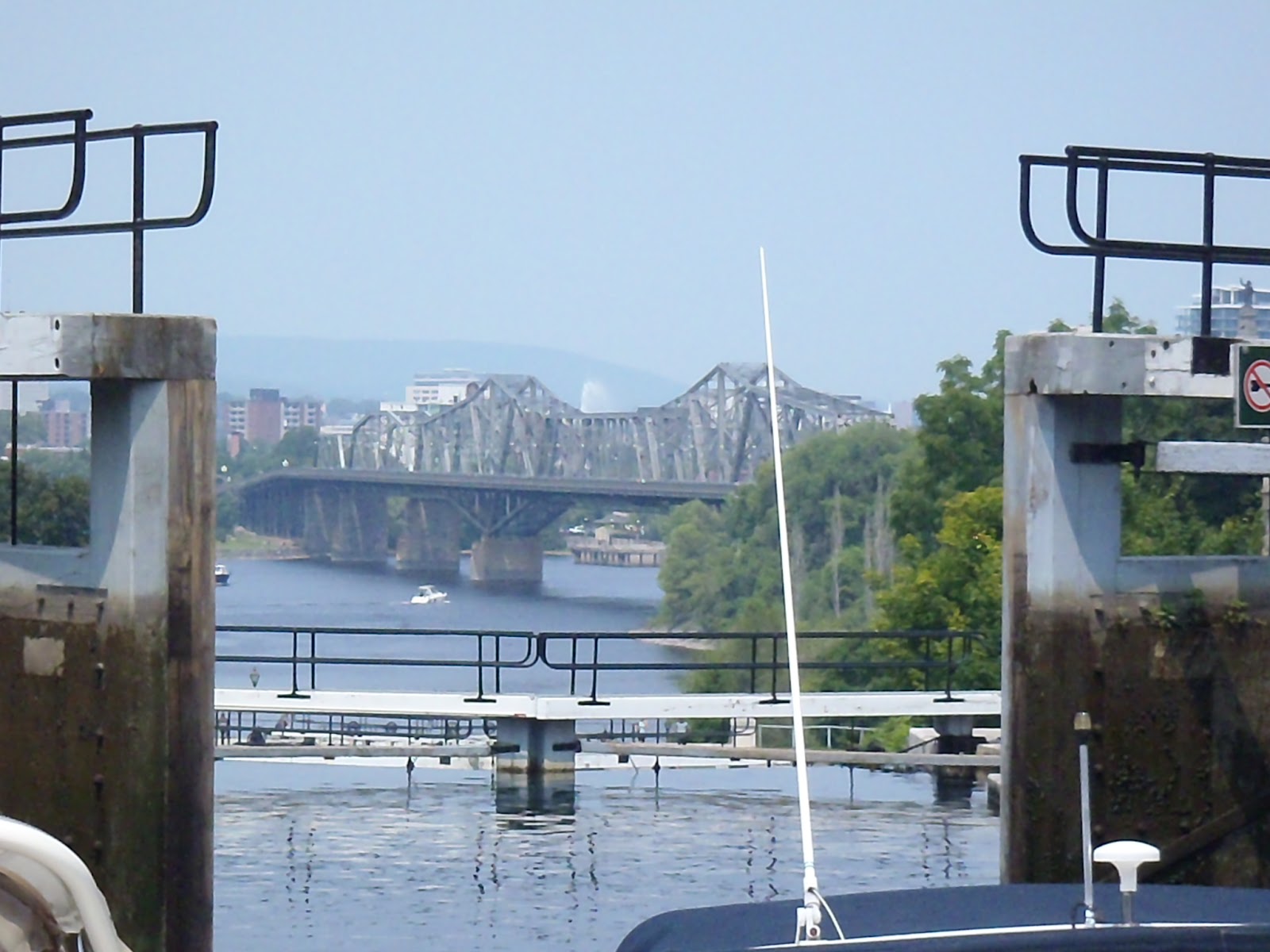
We leave the dock at the Carillon Canal by 6:15 and make our way towards Ottawa, Canada's capital city.  We are now on the Ottawa River and will soon be entering the Rideau Canal.  The Ottawa River is a busy waterway through two provinces---Quebec on the north and Ontario on the south. The Rideau Canal is the oldest, continually operating canal in North America and it has most of its original technology intact and most of its lock stations are unchanged from 175 years ago.  This canal is also run by Parks Canada. To complete this canal, we will need to pass through 49 locks.  The ride is very scenic and the traffic on the waterway is almost non-existent until about noon.  It then begins to fill with small pleasure crafts.  We pass by Le Chateau Montebello, the estate of Louis Joseph Papineau, a leading figure in the history of Canada. In 1929, the estate was sold to the Canadian Pacific Railroad and was used as a Sportsmen's Club.  In 1930, the Club built a log cabin which is said to be the largest log cabin in the world.  Today, it is part of the Fairmont hotel chain.  Parks Canada owns and operates Papineau's manor and surrounding buildings.  Unfortunately, I did not get a photo that did the estate justice.  Around 3:30 we pass by Rideau Falls where large homes, government buildings, embassies, and official residences line the high, tree-capped bluffs on the Ontario bank.  We can see the city of Ottawa ahead.  We will be beginning the Rideau Canal soon.  The first task will be for us to lock through the Ottawa Staircase which is a flight of eight locks.  This flight provides a spectacular 79-foot total vertical rise for us.  Locking will take at least 90 minutes.  The entrance to the lock is beautiful.  Bridges, the Parliament building, the Chateau Laurier (a Fairmont hotel) all loom in front of us as we tie up on the blue line (a designated area for boats wishing to lock through) to await our turn.  I climb the lock flights to the information office and learn that we have missed the last upstream locking of the day.  It began at 3:30 and it is now 3:45.  We will have to wait until tomorrow to experience the staircase.  We stay below the lock for the evening.  The area is very busy with lots of tourists.  The first lock through is tomorrow morning at 9:00, but the lock master will not know until the morning whether he will begin by locking downstream or upstream.  We hope it is upstream, of course.  Later in the afternoon we are joined by another boat, "Eden".  We meet her captain, Rick, and his first mate Paulette.  They live in Sainte Anne de Bellevue.  They lived in Ottawa for five years so they are a wealth of knowledge.  We will be locking through with them tomorrow morning.


Water falling from lock at the staircase

"At Last" waits her turn at the Ottawa Staircase
Chateau Laurier
Locksman manually opening the lock
July 6, 2015

At 8:45, Dave and I head to the lock house to see when we will be locking through.  At 9:10, the lock master informs us that we will be locking through first.  There are six boats that will lock through together.  We are the largest and will take the first position on the starboard side of the lock throughout all eight locks.  Unfortunately for us, as we enter the lock, one of our large fenders catches on the cleat at the bottom of one of the lock cables and it pops, making quite an explosive sound.  Loading the first lock takes the longest, but soon we quicken our pace as we pass through the eight locks.  But the locking still takes us over an hour and a half.  We exit the lock first and take a spot on the wall.  Tonight we will also have electricity.  Our plan is to stay in Ottawa for a couple of days.  We have lunch with Rick and Paulette from "Eden" and they give us many suggestions as to where to go and what to do.  After lunch, we walk with them into the city and they show us the Byward Market and the shopping areas…Rideau Centre and the Bay.  They leave us to ourselves as they head elsewhere.  Dave has been anxious to get a haircut so I find a barber shop/salon in the Rideau Center where we both get haircuts.  Dave is now sporting a crew cut.  It is a look I have never seen on him, but he looks great.  After a welcome to Ottawa margarita, we visit the Byward Market. It is amazing.  We are quickly reminded of the open air markets we visited in France.  We do a little shopping….fresh bread, cheese, fruit, veggies, pastry.  When we return from the market, there are several more boats along the wall.  We meet the folks on "Hope" which has a hailing port from East Greenwich, RI.  A couple from Boca Raton on Diva Di are heading in the opposite direction from us and "Daisy"whom we met when going through the Montreal locks takes a spot on the wall to await the folks from the "Blue Willow".  We have a European style dinner.  The forecast for tomorrow is rain.  We hope to get a chance to see the changing of the guard at the Parliament building.

Dave locking through the staircase

Gail doing her part of locking

Locksmen at work

Climbing higher in the staircase
Booth in Byward Market


Byward Market


Dave's new look

July 7 & 8, 2015

It's a hazy, hot, and humid day in Ottawa.  We walk the wall and meet several people.  After lunch we transfer photos to our flash drive so that we can use the new digital picture frame we picked up in the Rideau Centre.  It is quite a long process. At 4:00, we have cocktails with the Blue Willow, Diva Di, Eden, and Coeur Lion.  Richard and Nicole are on this boat and we learn that they are on their second day of their Great Loop adventure.  We all wish them well.  Dave and I walk into the city for dinner and a gelato. We get back to the boat just as it begins to rain.

We awake in the morning to a beautiful day of sunshine and low humidity.  We decide we really need some groceries so we walk into Ottawa again.  We go to the Metro a small, but well stocked grocery store.  We load up on bottled water and some basics.  We "borrow" the shopping cart and push it all the way back to the boat.  We are in a city and most people don't even seem to notice what we are doing. At the boat, we store our provisions and then walk back to the Metro store to return the cart.  A quick stop at Byward Market to pick up some fresh corn and more tomatoes and then it's back to the boat to get ready to leave.
Bag Lady???
We leave the wall, but we do not get very far because the bridge is closed due to lunch hour traffic.  We tie up to the wall, have lunch and await the return of the bridge keeper.  At 1:15, the bridge is opened for us.  It is a lift bridge.  We head to Dow's Lake Pavilion for water and a pump out.  We then lock through Hartwell Locks-9 & 10; Hogs Back Locks-11 & 12; and Black Rapids-Lock 13 where we stay for the night.  Before entering this last lock of the day, we see a grass collecting machine.  There is a lot of grass and foliage in the canal and lock system and every day we must check our strainers for the engine, generator, and air conditioner to make sure they are clean.
Lift bridge leaving Ottawa
Bridge's gear mechanism

Grass Catching Machine

Canada appears to provide its youth with many recreational opportunities and on our way to Lock 13 we see many kids enjoying themselves at a canoe club.

Canoe Club
July 9 & 10, 2015

We leave Black Rapids and plan to arrive at Long Island, a flight of three, locks 14, 15, and 16 by 9:00 so we can catch the first lock through.  It is overcast most of the day.  We lock through several locks and see the warning signs to be aware of the rapids as we make our way.  We cruise the Rideau for the day. We are alone in all the locks until we reach the Merrickville Locks, 21, 22, and 23.  In this flight of locks we are joined by a pontoon boat and a 38' Bayliner, a Canadian boat.  As we are locking through, the Canadian woman asks me if we are staying in Merrickville.  I answer that we plan to if there is room on the wall for us.  She informs me that they are staying there and that they have reserved a spot with electricity.  I simply smile and say that we hope to get a spot.  In the next lock of the flight, the lock master tells Dave we can have the last spot on the wall with electricity for the night.  My Canadian "friend" is not happy when she learns this.  In very loud French she complains to her husband that they have given the last spot to the Americans.  She goes on and on and on.  I simply continue to lock through, never letting on that I have heard and understood everything she has said.  In the last lock of the flight she is still complaining, only this time it is to the lock master.  He calmly explains to her, in French, that we are getting the spot on the wall because we were first, not because we are Americans.  She finally calms down when the lock master gives her a spot on the "blue line" and an extension cord so she can have 15 amp power for the night.  As the lock master helps us into our spot on the wall, I apologize to him in French for upsetting the lady by getting the last spot.  He laughs hysterically when he realizes I have understood everything that has been being said and the Canadian lady was totally unaware of this.  To be honest, this woman was the first unpleasant Canadian that we have encountered.

Merrickville is a delightful, historic town and Dave and I walk into the village for dinner.  We have a nice dinner at a pub with a Charles Dickens theme.  The menus are actually tattered Dickens novels with the menus made to fit inside the book.  Very clever.

Approaching the dam
The Dam
On Friday we leave by 8:00 to get to our first lock of the day, Kilmarnock, lock 24.  Again we are alone in this lock and in the Edmonds lock #25.  The passage between these two locks is through one of the Rideau's dammed, lake-like regions.  It consists of drowned land with hidden stumps and swampy, reedy shores.  At locks 26 and 27, Old Slys Lock, we are joined once again by our Canadian friends from the previous day.  The next lock is Smiths Falls, lock 29A.  This lock has replaced a flight of three locks, 28, 29, and 30.  The old locks are still in place today and can be seen on your left as you enter the modern 145 foot long hydraulic lock which will raise us 26 feet.  We had planned to stop here for a few hours, but it is very busy and we continue instead. The Canadians, however, stay in Smiths Falls. We enter the Poonamalie Lock, #32.  While speaking with the lock master, we learn that the lock master's house at this lock is still occupied today.  It was built during the War of 1812 as a "Defendable Lock House".  During this time the lock master was in charge of defending the canal from any attacks by the Americans. The gentleman who lives in the house today must bring any supplies he needs, groceries, lumber, furniture, etc. across the bridge formed by the closed doors of the lock.  This is his only access to the house and it is a very narrow passage.  It is very interesting to imagine living like this.  After locking through this lock, we begin our passage across the Lower Rideau Lake, the Big Rideau Lake and the Upper Rideau Lake.  Our next lock is the Narrows, #35.  It is located in a beautiful setting.  There are people enjoying themselves on their boats, at picnic tables, in lawn chairs.  This is the first time we have seen so many people just sitting around relaxing and enjoying the day.  It is almost as if we are being judged on our locking ability as they watch us in the lock.  This lock is also the first lock in which we will descend.  Up until this point we have been rising in each lock.  There is no room at the Narrows so we lock through the Newboro Lock, #36 and spend the night there.

Along the Rideau
Rocks on both sides.  Stay in the center!
Exiting a narrow passageway
Beautiful, crystal clear water
July 11, 2015


We leave the Newboro Lock for our final day of cruising before we reach Kingston.  The scenery is breathtaking and varies between wide open spaces on the Rideau Lakes, narrow, crooked passageways, narrow gorges, and islands with cottages and docks.  We continue to Jones Falls, lock # 39, 40, 41, & 42.  This lock is considered to be one of the most impressive engineering feats on the canal. It is a complex four stage lock with a center pool. Sweeney's House is the old lock tender's house.  It is completely restored to reflect the way the first lock tender and his family lived.  We decide to lock through and then stop on the other side for lunch.  We eat at the snack bar affiliated with Hotel Kenny, built in 1877.  This hotel is the Rideau's oldest resort.  After lunch, we lock through the next three locks until we reach the Kingston Mills flight of four locks, #46, 47,48, & 49.  This is where the river once turned grist and sawmills.  The Kingston Mills blockhouse is restored to its 1830s condition.  Interpreters dressed as 19th-century militiamen give musket-firing demonstrations, answer questions about the exhibits and explain the military's involvement in the canal's history.  A home formerly provided for the lock master is converted into a small museum and a small power generating station now stands on the site of the old mill.  We decide to spend the night on the wall below the lock.  After dinner, Dave discovers that the center bilge pump is not working.  He also needs to tighten the "stuffing box" once again.  Alas, more repairs for "At Last".  Tomorrow we will try to find a place in Kingston to accomplish the task.

Continuing along the Rideau
Locking into the pond
The Rideau Heritage Route
Need to be careful of the grasses and reeds on the bottom
Pleasure boats tied up at the lock for the day